This commentary concerns an 8/22/2015 post by the Libertarian blogger Willis Hart in which he calls out Democratic presidential candidate Bernie Sanders for a number of supposed "fallacies" that aren't fallacies.
The first of these bogus claims by Hart was that Bernie Sanders said "the economy is a fixed pie and that the only real question is how to divvy it up". I debunked this "fallacy" with OST #68 by pointing out that Bernie Sanders talks about income inequality, not divvying up pies.
Next, I proved that Willis was BSing his readers (as well as himself) when he said Senator Sanders was lying about Bernie saying "the poor and middle class are worse off than they were decades ago" (with OST #70). I showed that, by and large, they ARE worse off.
The third of Willis' phony "rank fallacies" I will debunk as follows.
| Willis Hart: The Rank Fallacies of Bernie Sanders... c) That high tax rates on the wealthy don't have negative consequences (mainly that the rich will simply alter their behavior). (8/22/2015 AT 3:13pm). |
The wealthy will alter their behavior, of course, but the benefits of raising taxes outweighs the negatives... as per an article by Chye-Ching Huang, a Senior Tax Policy Analyst at the Center on Budget and Policy Priorities.
| Opponents of raising the taxes that high-income households face often point to findings that high-income taxpayers respond to tax-rate increases by reporting less income to the Internal Revenue Service (IRS) as evidence that high marginal tax rates impose significant costs on the economy. However, an important study by tax economists Joel Slemrod and Alan Auerbach found that such reductions in reported income largely reflect timing and other tax avoidance strategies that taxpayers adopt to minimize their taxable income, not changes in real work, savings, and investment behavior. While such strategies entail some economic costs, these costs are relatively modest. (Recent Studies Find Raising Taxes on High-Income Households Would Not Harm the Economy by Chye-Ching Huang. CBPP 4/24/2012). |
OK, so the negative consequences of high tax rates on the wealthy are actually only "relatively modest". But, beyond those "relavively modest" negative consequences, we have the fact that it is actually a lot more harmful to the economy for tax rates to be TO LOW, as David Cay Johnston, an investigative journalist and author who specializes in economics and tax issues, speaks to in the following article (excerpt).
| ...while tax rate cuts can stimulate the economy immediately and, if well designed, encourage the savings and investment to support long-term growth, they can also do harm. When cuts are financed with borrowing, as they have in the post–Ronald Reagan tax-cutting era, it just pushes tax, plus interest, into the future. How taxes are cut matters too. Tax cuts can discourage work, create windfalls for existing investments without encouraging new investment and tilt the playing field in ways that produce unproductive investments. (Tax cuts can do more harm than good by David Cay Johnston. al Jazeera America 9/18/2014). |
As opposed to high tax rates discouraging work because high wage earners don't like it that the government takes so much, the reverse is actually closer to reality... high wage earners may be likely to work less if they are taxed less. Because why work as hard as you did (pre-tax cut) when you can work less and net the same money?
By the way, yes, this applies to high wage earners, because these are the kind of workers who have the ability to set their own hours. At least more often than middle and lower income wage earners, who ususlly can only work the hours they are given by their employers.
In regards to tax rate cuts that stimulate, these would be tax cuts on middle and lower income wage earners, because most working people spend all that they earn. With more money in their pockets, these workers are spending more (and thus stimulating the economy more).
Rich people, on the other hand, are more likely to stash that money in a (possibly offshore) bank account, or look for an investment they can put their tax cut money into... which, might sound like it would be economically stimulative, but could actually be economically harmful. Very harmful, in fact.
| [Author] Larry Beinhart... looked over the history of tax cuts and economic bubbles, and found a clear relationship between the two. High top marginal tax rates (generally well above 60%) on rich people actually stabilize the economy, prevent economic bubbles from forming, prevent economic crashes, and lead to steady and sustained economic growth (and steady and sustained wage growth for working people). On the other hand, when top marginal rates drop below 50 percent, the opposite happens. As Beinhart noted in a November 17, 2008 article on the Huffington Post, the massive Republican tax cuts of the 1920s (from 73% to 25%) led directly to the Roaring '20s stock market bubble, temporary boom, and then the crash and Republican Great Depression of 1929. (The Great Tax Con Job by Thom Hartmann. Huff Post Politics 5/25/2011). |
According to Larry Beinhart's 2008 article (the one Thom Hartmann references)...
| Large income tax cuts are followed by a bubble and then a crash. High income taxes correlate with economic growth. Income tax increases are followed by economic growth. Moderate income tax cuts are followed by a flat economy. (Tax Cuts: Theology, Facts & Totally F**ked by Larry Beinhart. Huff Post Politics 12/18/2008). |
george w. bush, aside from totally f*cking us by creating ISIS when he ordered the invasion of Iraq, also f*cked us by lowering taxes on the wealthy, which (along with the deregulation of Wall Street) lead to the housing bubble that crashed the economy.
Tax cuts on high income earners historically lead to bubbles and crashes, as Beinhart shows in his article. His examples are Hoover, Reagan and bush the lesser... all presidents whose tax cuts were followed by recessions. (The Bush Tax cuts CAUSED the economic crisis).
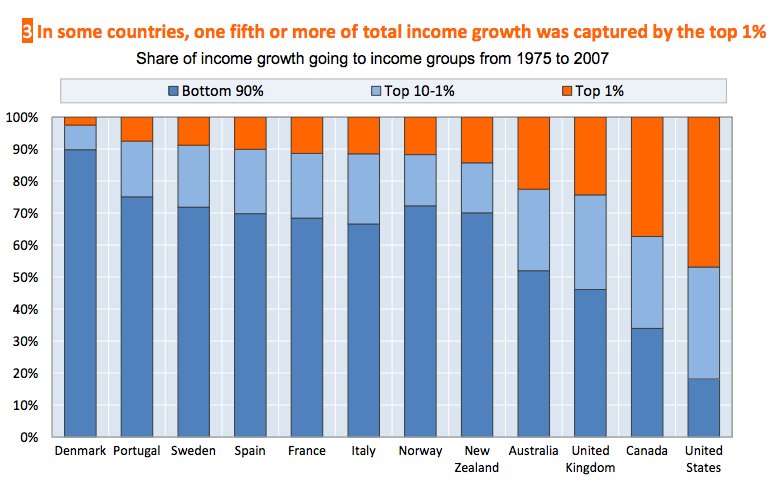
Given these facts, why the hell would anyone argue against raising taxes on wealthy individuals as Willis Hart does, saying there are "negative consequences"? The consequences are CLEARLY negative when taxes are too low and POSITIVE when they are higher. And because tax rates have been too low since the Reagan presidency is why middle class wages have been largely stagnant for the past 30-plus years... and why lower-income workers are losing ground (see chart below).
Bernie Sanders knows this. Instead of being a "rank fallacy", Bernie Sanders, in advocating for higher marginal tax rates, is an economic truth-teller. And Senator Sanders' truth-telling on this matter strongly illustrates why this man should be our next president. Hillary Clinton, while she might be in favor of a small increase, isn't a Progressive.
I'd say it's doubtful Hillary would support the Congressional Progressive Caucus' (CPC) People's Budget which "creates fair tax rates for millionaires and provides needed relief to low- and middle-income families". (The People's Budget "returns to Clinton-era tax rates for households making over $250,000 and implements new brackets for those making over $1 million"... the top rate, for people making more than $1 billion, is 49 percent).
Bernie Sanders, given that he's he is one of six Progressives who established the CPC in 1991, absolutely would support the People's Budget (or some variant of it that raised taxes on higher-income earners up to around 50 percent). A president Sanders would push a budget that would stop the very negative consequences of bubble-and-bust caused by taxes that are too low. Frankly I'd call ignoring this consequence is "rank fallacy" of the Hartster, not Bernie Sanders. Bernie Sanders acknowledges this truth, while Willis embraces Libertarian/Conservative lies about it/pretends the opposite is true.
Image: This chart shows that in recent decades the rich are getting richer, the middle class and poor got richer, then poorer... with the poor worse off in 2010 than they were in 1983... so poor households are worse off than they were decades ago, both in relative and absolute terms. (Chart source: The Lost Decade of the Middle Class. Pew Research Center 8/22/2012).